
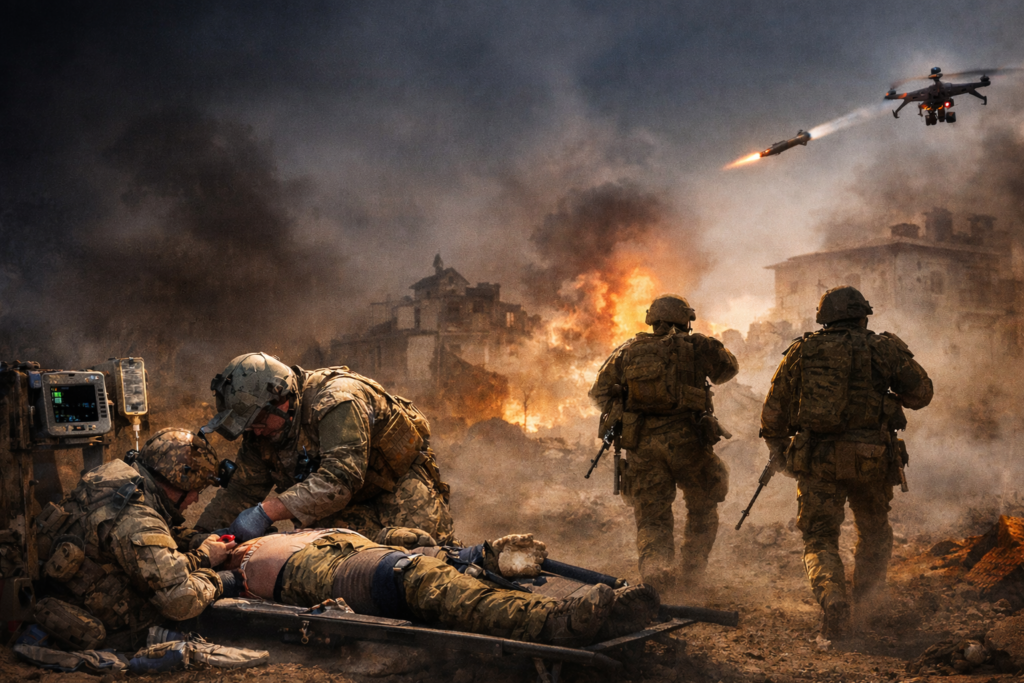
For decades, military medicine has been built around a comforting assumption: that there will always be a place behind the fight where casualties can be evacuated, stabilised, and treated in relative safety. That assumption no longer holds. Modern near-peer warfare has erased the idea of a predictable frontline and replaced it with something far more unsettling. We now operate in fluid, omnidirectional killzones, where threats emerge from everywhere and evacuation routes can collapse without warning.
In this environment, the traditional forward surgical post is not just outdated. It is dangerously exposed. Static medical infrastructure, heavy equipment, and reliance on linear evacuation chains make medical teams visible, targetable, and increasingly unsustainable. If we are serious about saving lives in future conflicts, we need to rethink not just where care is delivered, but how and by whom.
This is where the concept of the Four-Person Expeditionary Surgical Team, or EST, becomes essential.
A Capability Shaped by Reality, Not Nostalgia
The EST is not a scaled-down hospital. It is not an aspirational concept built for ideal conditions. It is a deliberately minimal, highly mobile surgical capability designed to function where evacuation is delayed, unreliable, or impossible. Its purpose is simple but profound: to deliver immediate, high-value trauma care at the point where casualties fall, while retaining the ability to move before becoming a target.
This is not definitive surgery. It is damage control with intent. It is the difference between a casualty bleeding to death while waiting for evacuation that never arrives, and a casualty who lives long enough to reach the next echelon of care.
Why Four People Are Enough, and More Would Be Too Many
The strength of the EST lies in its restraint. Every additional person increases the logistical burden, the signature, and the vulnerability of the team. Four is not an arbitrary number; it is the minimum required to deliver meaningful intervention without sacrificing survivability.
The surgeon is either orthopaedic or general, but critically trained in advanced vascular control. Their focus is not the abdomen or the chest, but the injuries that kill quickly and are most salvageable when treated early: limb and junctional haemorrhage, blast and shrapnel wounds, mangled extremities. They must be able to clamp, shunt, debride, stabilise, and decide, often within minutes, whether a limb can be saved or whether amputation is the only life-preserving option.
The anaesthetist is the physiological anchor of the team. In austere, hostile environments, airway control, analgesia, shock management, hypothermia prevention, and regional anaesthesia are not luxuries; they are survival tools. This clinician must be comfortable delivering care without the safety net of a theatre, managing physiology while the tactical situation continues to evolve.
The remaining two team members are specialist frontline combat medical practitioners. They are not conventional medics. They are clinicians who understand both medicine and threat. They control haemorrhage, assist with procedures, manage transfusion, carry equipment, provide protection, and extract casualties when the moment comes. They are the reason the team can function inside the killzone rather than waiting outside it.
Minutes Matter More Than Infrastructure
The EST operates on a different clock. Interventions are measured in minutes, not hours. The aim is rapid stabilisation, not perfection. Every decision is filtered through a single question: can we still move after this?
All equipment is carried by the team. If it cannot be moved rapidly, it does not belong. Tourniquets, junctional devices, temporary vascular shunts, clamps, compact surgical instruments, splints, antibiotics, regional block drugs, lightweight monitoring, and field-ready blood products are chosen not because they are elegant, but because they work.
Care is delivered in dust, smoke, uneven terrain, and imperfect conditions. Antibiotics are given where they can be given. Nerve blocks are performed where the casualty lies. Wounds are cleaned with what is available. The goal is not textbook aesthetics. The goal is survival.
Mobility Is Not a Feature, It Is the Doctrine
In near-peer conflict, anything that stays still long enough will eventually be found. Mobility is therefore not a tactical consideration layered on top of clinical care; it is the doctrine. The EST must be able to reposition immediately, to extract casualties when opportunities arise, and to disappear before becoming a predictable node.
This distributed, low-signature approach fundamentally changes the medical architecture of the battlefield. Instead of a few large, vulnerable facilities, multiple small teams create redundancy and resilience. Losing one does not collapse the system. This is not just safer; it is smarter.
Why This Matters Now
Evacuation chains are fragile. Air superiority cannot be assumed. Drone surveillance and precision munitions punish static positions. Mass casualty events can occur before any traditional surgical facility is established. These are not hypothetical scenarios; they are features of contemporary conflict.
If trauma systems do not adapt to this reality, casualties who could have survived will die unnecessarily. The EST model directly addresses this gap. It brings care forward, reduces dependence on evacuation, and aligns medical practice with the operational truth of modern warfare.
A Necessary Evolution
The Four-Person Expeditionary Surgical Team is not a replacement for higher-echelon care. It is the bridge that allows casualties to reach it alive. By combining a compact team structure, advanced clinical skill, tactical compatibility, and disciplined restraint, the EST represents a necessary evolution in deployed medical capability.
This is not innovation for its own sake. It is medicine shaped by reality. And if future conflicts are to be fought ethically as well as effectively, this kind of thinking must become doctrine rather than exception.
This is not a new concept. In the 1990’s 5 person FASTs (Forward Aeromedical Surgical Teams) were developed and deployed by the USAF under the direction of LtGen Paul K. Carton, M.D. The principles described above were used as we developed the teams to include personnel, skills (medical and military), equipment, logistics, and protocols for both team survival as well as care. These teams – modified as lessons were learned – are still a key part of Air Force medicine. Might reach out to myself or some of the great military medical folks who have already traveled this road.
Hopefully not being new will mean it is more stream lined to implement, as and when required. And thank you for the offer of assistance. I will reach out if there are any gaps identified.
BEING A MILITARY ANAESTHETIST WITH EXPERINCE IN HOSTILE ENVIRONMENTS SUCH AS SOMALIA WHERE THE MAIN SUPPLY ROUTES ARE OFTENLY BARRICATED ,CASUALTIES OFTENLY DIE AS THEY AWAIT FOR REINFORCEMENT AND AVAILABILITY OF ALTERNATIVE ROUTES TO BE CREATED.
I THEREFORE AGREE TOTHIS CONCEPT AND ADVOCATE FOR ITS ADOPTION.
Dear Dr Jagero. Thank you for your valuable contribution.