There is a great deal of conversation at the moment about prolonged field care, about evacuation denial, about scarce skill sets, high-value clinicians, and the limits of logistics in modern warfare. These are serious discussions, and they deserve to be had. But as I listen to them, I am struck by a recurring omission, one so obvious that it has somehow become invisible.
We keep talking about resources, but we rarely pause to acknowledge the most important one of all.
The soldier.
Not as a concept.
Not as a capability.
Not as a unit of combat power.
But as a person.
When Language Drifts, So Does Perspective
Over time, language has a habit of smoothing away discomfort. We speak of manpower, force generation, attrition, and acceptable risk. These terms are useful, but they are also dangerous. They allow us to distance ourselves from the reality that the individuals we deploy forward are not abstractions. They are people who have willingly stepped into harm’s way to execute decisions made far from the point of contact.
When we debate prolonged field care purely as a doctrinal problem, something important is missing. When we discuss whether medical capability should move forward because it is “resource intensive”, without first considering the human cost of delay, we reveal more than we intend.
It is not that the discussions are wrong.
It is that they are incomplete.
The Soldier Is Not a Line Item
The soldier lying injured on the battlefield is not a variable in an equation. They are not an inconvenient consequence of a failed evacuation plan. They are not a theoretical casualty used to test the resilience of a system.
They are someone’s husband or wife.
Someone’s son or daughter.
Someone’s mother or father.
Someone who matters profoundly to people who are not in the room when these decisions are debated.
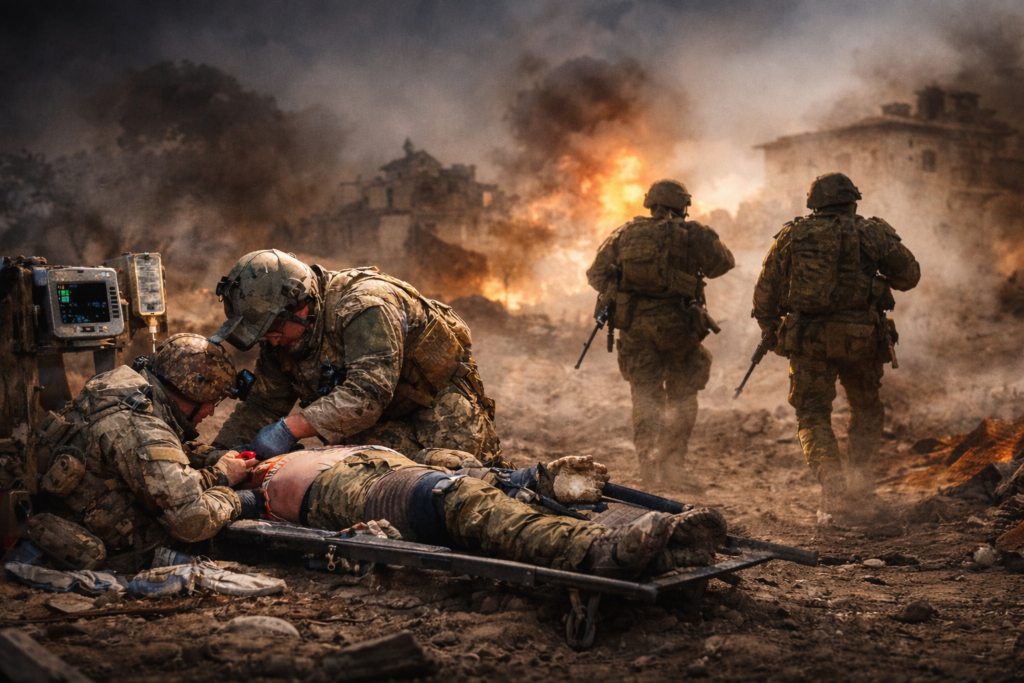
When they are wounded, they do not experience doctrine. They experience pain, fear, confusion, and isolation. They do not care whether their situation fits neatly into a concept of operations. They care whether someone is coming. Whether someone can help. Whether they will be left where they fell because the system decided it was too difficult to reach them.
Prolonged Field Care Is Not a Choice
Prolonged field care is often spoken about as if it were a deliberate strategy. In reality, it is almost always a consequence. It happens when assumptions fail. When evacuation collapses. When airspace closes. When routes disappear. When the battlefield evolves faster than our planning models.
No one chooses prolonged field care. It is endured by the casualty.
The ethical question, then, is not whether prolonged field care is acceptable, but whether we have done everything possible to reduce the burden it places on the individual who is already paying the price.
High-Value People and the Cost of Hesitation
There is understandable anxiety about deploying highly trained medical personnel forward. They are scarce. They take years to train. They are, quite rightly, valued.
But so is the soldier bleeding in the dirt.
Every decision to hold capability back in the name of preservation is also a decision to accept risk, and that risk is not borne by planners or committees. It is borne by the injured individual and, ultimately, by the people who love them.
Caution has a cost.
So does inaction.
We need to be honest about who pays it.
Why This Matters More Than We Admit
Soldiers fight differently when they believe that if they are wounded, they will not be forgotten. That belief shapes morale, cohesion, and willingness to accept risk. Medical care is not a peripheral function of combat power; it is part of its moral foundation.
When trust in that care erodes, the consequences ripple far beyond medicine.
Remember the Person
At the end of every discussion about logistics, doctrine, feasibility, and capability, there should be a moment of pause. A moment where we ask a very simple question:
What does this mean for the individual who gets hurt?
If we cannot answer that clearly, then we are designing systems for our own reassurance rather than for the people who will live with the consequences.
The soldier on the frontline is the most precious resource we have. Not because they are useful, but because they are human beings who willingly place their lives at risk to fulfil decisions made by others.
The least we owe them is remembrance, not after the fact, but in the way we think, plan, and act.
Anything less is not a failure of logistics or technology.
It is a failure of perspective.