
We tend to imagine the next war using the language of the last one.
Frontlines. Forward operating bases. Evacuation corridors. Protected rear areas. Helicopters lifting casualties within the golden hour. Surgical units working with some degree of distance from direct threat.
That mental model is increasingly outdated.
Future conflict will not present itself as a tidy line on a map. It will be fluid, omnidirectional, and persistent. There will be no reliable “rear”. No safe depth. No predictable pause between contact and consequence.
And that reality carries profound implications, particularly for those of us responsible for preserving life within it.
The Disappearance of the Frontline
The defining feature of near-peer conflict is not merely increased lethality. It is increased visibility.
Surveillance will be continuous. Small unmanned systems will observe from above. Sensors will detect movement and signature. Static positions, including medical facilities, will not remain concealed for long. Anything that does not move becomes a target.
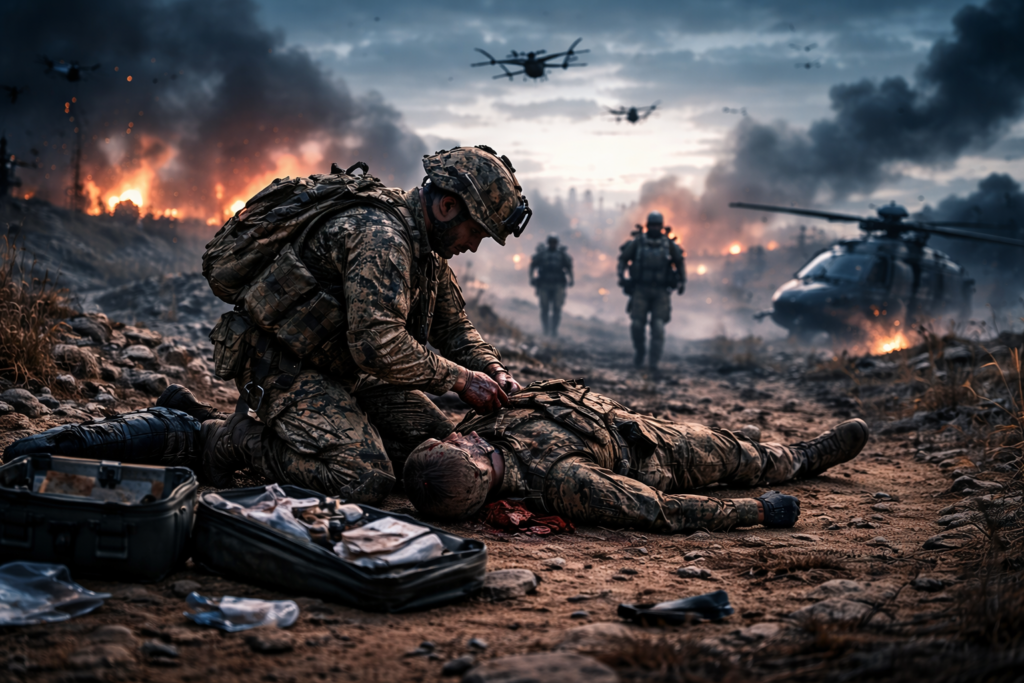
Airspace will be contested. Evacuation by air will be intermittent, dangerous, and at times impossible. Ground evacuation will be disrupted by precision fires, electronic interference, and terrain denial. Communications will degrade. Navigation systems will be jammed.
The idea that casualties will be reliably moved along a protected chain of care is, at best, optimistic.
Evacuation May Not Come
We have built modern trauma systems on the assumption of timely evacuation. The golden hour became doctrine because it was achievable. That assumption now requires scrutiny.
In future conflict, evacuation may be delayed for hours. It may be denied entirely. The casualty may remain where they fell far longer than we are comfortable admitting.
That is not alarmism. It is realism.
When evacuation becomes uncertain, the burden shifts forward. Life-saving interventions must occur closer to the point of injury. Haemorrhage must be controlled definitively enough to survive delay. Physiology must be stabilised without the safety net of a nearby intensive care unit.
The system must assume interruption rather than continuity.
The Nature of Injury Will Not Be Gentle
High-energy blast, fragmentation, complex polytrauma, and simultaneous casualties will define the injury pattern. These will not be isolated limb wounds with straightforward trajectories. They will be multi-system insults delivered in environments that are hostile, unstable, and unforgiving.
And medical teams will operate under threat themselves.
This is not a theatre of elective surgery. It is medicine conducted while the environment remains volatile.
Mobility Is No Longer an Option
If there is one principle that will define survivable medical capability in future conflict, it is mobility.
Large, static facilities may feel reassuring. They signal permanence and strength. But permanence invites targeting. Infrastructure that cannot move will eventually be found.
Resilience will lie in smaller, distributed, mobile capability. Teams that can intervene, stabilise, and relocate. Systems that do not collapse when one node is compromised.
Mobility will not be an added feature. It will be doctrine.
Technology Will Not Solve Everything
There is understandable enthusiasm for technological solutions, autonomous evacuation, remote monitoring, robotics, artificial intelligence. Some of these innovations will add value. But we must remain sober.
Weapons and countermeasures evolve faster than medical systems. What works briefly may be neutralised quickly. Overreliance on fragile technology in a degraded environment is a strategic risk.
Fundamentals endure.
Bleeding must be stopped.
Airways must be secured.
Shock must be managed.
Those principles do not change with bandwidth.
The Moral Centre Must Remain Intact
Amid all this, it is easy to focus on doctrine, logistics, and survivability of capability. But we must not lose sight of the individual at the centre of all this planning.
The soldier will continue to step forward into harm’s way. They will do so with the expectation, often unspoken, that if they are injured, the system will do everything possible to preserve their life.
If future conflict erodes evacuation, then our responsibility increases, not decreases.
We must design systems that reflect reality rather than nostalgia. We must acknowledge that the battlefield has changed. And we must adapt without compromising the moral obligation that sits at the heart of military medicine.
A Final Reflection
Future conflict will be faster, more visible, more lethal, and less forgiving of static assumptions. Medical systems that cling to outdated models will struggle. Those that embrace mobility, decentralisation, disciplined restraint, and fundamental trauma principles will endure.
The battlefield will evolve whether we are ready or not.
The question is whether we will adapt our thinking in time, not simply to protect capability, but to preserve life in a landscape where certainty no longer exists.
That responsibility does not diminish with complexity.
It becomes sharper.